Hidden Places & Ancient Temples in Varanasi: A Sacred Spiritual Guide to Kashi
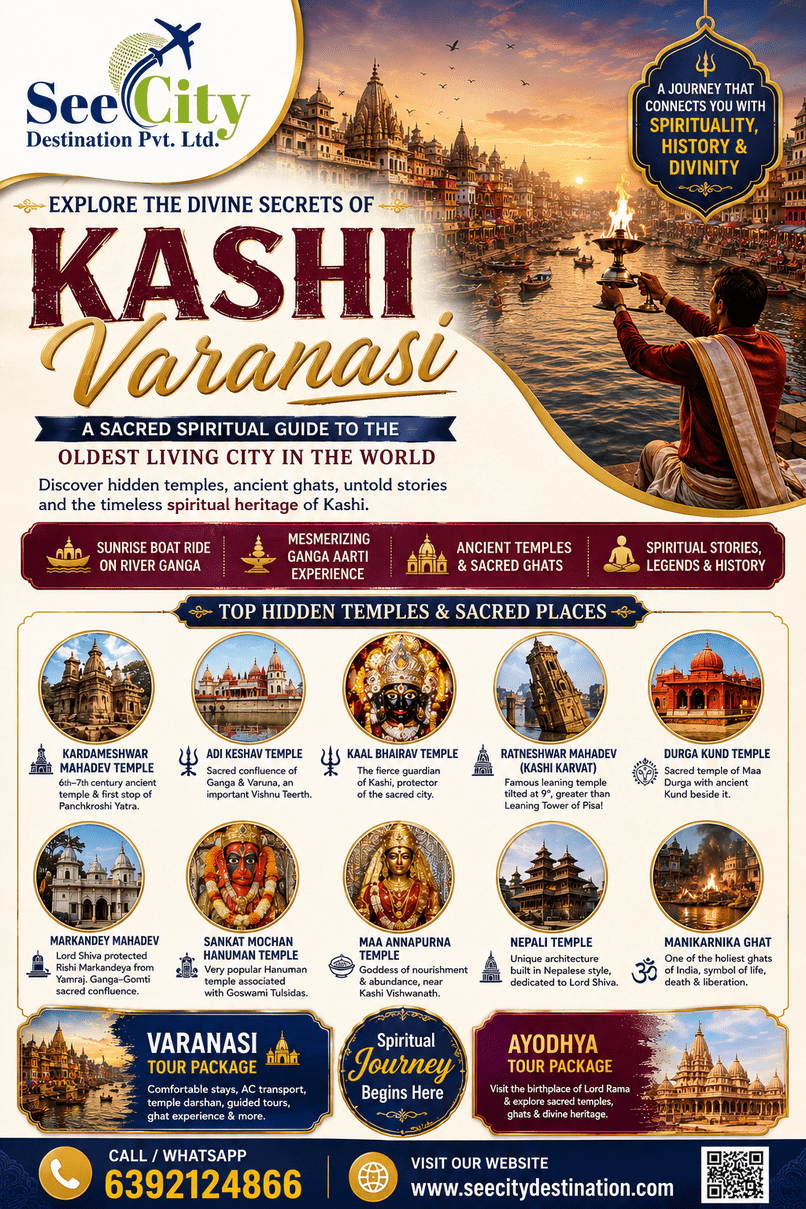

🕉️ Explore This Spiritual Guide
From ancient temples and sacred ghats to practical travel tips, explore the spiritual side of Kashi step by step.
🕉️ Table of Contents
🌺 Discover the Spiritual Soul of Kashi
Why Is Varanasi So Important in Hindu Religion?
Kashi & Lord Shiva
The Sacred Ganga
The Spiritual Meaning of Moksha
🛕 Ancient & Hidden Temples of Varanasi
Kardameshwar Mahadev Temple – An Ancient Temple of Kashi
Adi Keshav Temple – Where the Ganga Meets the Varuna
Kaal Bhairav Temple – The Guardian of Kashi
Ratneshwar Mahadev – The Famous Leaning Temple
Durga Kund Temple – The Sacred Temple of Goddess Durga
Markandey Mahadev Temple – A Story of Devotion & Protection
Sankat Mochan Hanuman Temple – The Power of Devotion
Maa Annapurna Temple – The Goddess of Nourishment
Nepali Temple – A Unique Architectural Treasure
🔱 Sacred Ghats & Spiritual Places
Manikarnika Ghat – Life, Death & Liberation
The Sacred Ghats of Varanasi
Assi Ghat
Dashashwamedh Ghat
Scindia Ghat
Man Mandir Ghat
🌿 Understanding the Deeper Kashi
Why These Sacred Places Matter in Hindu Religion
A Different Way to Experience the Spiritual Side of Kashi
🚗 Plan Your Varanasi Spiritual Journey
How to Explore the Hidden Spiritual Side of Varanasi
How Many Days Are Enough to Explore Varanasi?
Suggested 3-Day Varanasi Spiritual Itinerary
Best Time to Visit Varanasi
Important Temple Etiquette & Travel Tips
🛕 Varanasi & Ayodhya Spiritual Connection
Varanasi and Ayodhya – Two Important Spiritual Destinations
Important Places to Explore in Ayodhya
Planning a Varanasi & Ayodhya Spiritual Trip
Choosing a Varanasi Tour Package
Combining Your Journey with an Ayodhya Tour Package
❓ Frequently Asked Questions
FAQs About Hidden Temples & Sacred Places in Varanasi
❤️ Experience the Soul of Kashi
Final Thoughts – Discover the Spiritual Heritage of Kashi
Plan Your Spiritual Journey with See City Destination
Introduction
Varanasi, also known as Kashi or Banaras, is one of the most spiritually significant cities in India. Situated along the sacred River Ganga, the city has been a centre of pilgrimage, devotion, learning and culture for centuries.
For most visitors, a journey to Varanasi begins with the famous Kashi Vishwanath Temple, the evening Ganga Aarti at Dashashwamedh Ghat, a sunrise boat ride on the Ganga and the ancient lanes of the old city.
But Kashi has another side.
Beyond its most famous landmarks are ancient temples, sacred ghats, old shrines and religious sites that are less familiar to many travellers. Some are tucked away in narrow lanes, some are located away from the busiest tourist areas, and others are connected with centuries-old traditions and stories from Hindu religious literature.
Exploring these places can offer a deeper understanding of Varanasi—not simply as a tourist destination, but as a living spiritual city.
In this guide, we explore some of the ancient and lesser-known sacred places of Kashi and understand their importance in Hindu religious tradition.
Why Is Varanasi So Important in Hindu Religion?
Varanasi holds a unique place in Hindu religious tradition.
The city is traditionally associated with Lord Shiva, and Kashi is regarded as one of the most sacred pilgrimage destinations in Hinduism. The presence of the River Ganga, hundreds of temples, sacred ghats and centuries-old religious traditions has shaped the identity of the city.
The spiritual importance of Varanasi is not limited to one temple.
It can be experienced throughout the city—in the sound of temple bells, morning prayers on the ghats, rituals performed beside the Ganga, pilgrims walking through the ancient lanes and the countless shrines dedicated to different forms of Hindu deities.
Kashi and Lord Shiva
According to Hindu tradition, Kashi is closely connected with Lord Shiva. The city is therefore often described as the sacred city of Shiva.
The most famous expression of this connection is the Kashi Vishwanath Temple, where Lord Shiva is worshipped as Vishwanath, meaning "Lord of the Universe."

But the presence of Shiva in Kashi extends far beyond Kashi Vishwanath.
Across the city, visitors can find numerous Shiva temples and shrines, each associated with its own traditions, legends and local practices.
This is one reason why exploring the lesser-known temples of Varanasi can be such a meaningful experience for pilgrims and spiritual travellers.
Kashi and the Sacred Ganga
The Ganga is another central part of Varanasi's spiritual identity.
Pilgrims have traditionally come to the river to perform sacred baths, prayers and rituals. The ghats along the Ganga therefore form an important part of the city's religious landscape.
From the morning rituals at Assi Ghat to the evening Ganga Aarti at Dashashwamedh Ghat and the profound traditions surrounding Manikarnika Ghat, the river is deeply connected with the religious life of Kashi.
The Idea of Moksha
Varanasi is also strongly associated with the Hindu concept of moksha, or liberation from the cycle of birth and death.
Traditional beliefs surrounding Kashi have made it an important destination for pilgrims seeking spiritual liberation. This religious association is one of the reasons the city has attracted devotees, saints, scholars and spiritual seekers for generations.
For visitors, understanding this belief helps explain why Varanasi feels different from an ordinary historical city.
Kashi is not simply a place with old temples.
For millions of devotees, it is a sacred landscape.
1. Kardameshwar Mahadev Temple – An Ancient Temple of Kashi
One of the fascinating ancient temple sites of Varanasi is Kardameshwar Mahadev Temple, located in the Kandwa area.
Away from the busiest tourist routes, the temple offers visitors a chance to explore an older and quieter side of Kashi.
The official Kashi portal identifies Kardameshwar Mahadev as an ancient archaeological site and notes that the temple contains carved figures of divine dancers, musicians, snakes and mythical creatures dating to the 6th–7th centuries. The site is also protected by the Government of Uttar Pradesh under the state's ancient and historical monuments legislation.
Religious and Historical Significance
Kardameshwar Mahadev is dedicated to Lord Shiva and is associated with the traditional pilgrimage landscape of Kashi.
Its importance goes beyond its religious identity. The surviving stone carvings provide a glimpse into the artistic traditions of an earlier period of Indian history.
The temple is also connected with the Panchkroshi pilgrimage tradition, one of the important pilgrimage circuits associated with Kashi.
For travellers interested in both spirituality and heritage, Kardameshwar offers something different from the highly crowded temples in central Varanasi.
Why Visit Kardameshwar Mahadev?
A visit to this temple can be particularly interesting if you want to:
Discover an ancient Shiva temple away from the busiest tourist areas
See historic stone carvings
Understand the wider pilgrimage geography of Kashi
Experience a quieter side of Varanasi
Explore the connection between religious tradition and ancient architecture
Kardameshwar reminds us that the spiritual heritage of Varanasi is spread far beyond the famous landmarks.
2. Adi Keshav Temple – Where the Ganga Meets the Varuna
At the northern edge of the traditional Kashi area lies Adi Keshav, an important sacred site associated with Lord Vishnu.
The temple is located near the Varuna-Ganga confluence, an area that has considerable importance in the sacred geography of Kashi.
The official Kashi portal describes Adi Keshav Ghat as the place where the Ganga and Varuna meet and notes the traditional belief that Lord Vishnu first set foot in Kashi at this location. The site is also described as a Vishnu teerth.
Why Is Adi Keshav Important?
While Varanasi is often identified primarily with Lord Shiva, the religious landscape of Kashi includes important traditions connected with Lord Vishnu as well.
Adi Keshav is a good example of this wider spiritual character.
The location near the meeting point of the Ganga and Varuna adds another dimension to the site. Sacred river confluences have traditionally held an important place in Hindu pilgrimage, and Adi Keshav reflects this connection between sacred geography and religious tradition.
A Quieter Side of Varanasi
Compared with some of the central ghats, the Adi Keshav area can feel considerably more peaceful.
For travellers who want to explore beyond the standard Varanasi sightseeing route, this part of the city provides an opportunity to see a different side of Kashi.
The combination of the river, ancient religious traditions and the temple's association with Lord Vishnu makes Adi Keshav an interesting stop for a deeper spiritual exploration of Varanasi.
3. Kaal Bhairav Temple – The Guardian of Kashi
If Kashi Vishwanath represents one of the most important expressions of Lord Shiva in Varanasi, Kaal Bhairav represents another powerful aspect of the city's spiritual identity.
Kaal Bhairav is traditionally regarded as a fierce manifestation of Lord Shiva and is widely revered as the guardian of Kashi.
The Ministry of Tourism's Incredible India describes Kaal Bhairav as the spiritual guardian of Varanasi and notes the temple's deep connection with the religious traditions of the city.
The Religious Significance of Kaal Bhairav
In Hindu tradition, Bhairava is associated with protection, power and the removal of fear.
Devotees visiting the Kaal Bhairav Temple often seek blessings for protection, courage and spiritual strength.
A popular belief associated with the temple is that Kaal Bhairav is the guardian who watches over Kashi. Because of this tradition, many pilgrims consider seeking his blessings an important part of their visit to Varanasi.
What Makes the Temple Different?
The temple is located within the ancient lanes of the city, and its relatively narrow approach adds to the traditional atmosphere.
The main deity is represented by a distinctive silver-faced image, with the rest of the form covered according to the temple's tradition. Devotees commonly offer flowers and other traditional offerings.
The temple is also associated with festivals such as Bhairav Ashtami and Mahashivratri.
Why Include Kaal Bhairav in a Varanasi Spiritual Journey?
A visit to Kaal Bhairav helps travellers understand that the religious identity of Kashi is much broader than the Kashi Vishwanath Temple alone.
It introduces visitors to another important aspect of Shaiva tradition and to the belief that Kashi is protected by a divine guardian.
4. Ratneshwar Mahadev – The Leaning Temple of Kashi
Among the most visually unusual temples of Varanasi is Ratneshwar Mahadev, popularly known as Kashi Karvat.
Located near the Ganga, the temple is famous for its dramatic inclination towards the river.
The official Kashi portal states that the temple is tilted by nearly nine degrees, making its inclination greater than that of Italy's famous Leaning Tower of Pisa.
The Story Behind Kashi Karvat
Like many ancient structures in Varanasi, Ratneshwar Mahadev has a fascinating local tradition associated with its history.
According to the legend recorded by the Kashi official portal, a devoted servant built the temple for his mother, Ratna Bai. After believing that he had repaid his maternal debt, the temple became associated with a curse reminding him that a mother's debt can never truly be repaid.
The temple subsequently began to lean.
This is a traditional legend, rather than an established historical explanation for the structure's inclination.
The Architectural Mystery
The temple's physical condition is just as fascinating as its legend.
According to the Kashi portal, structural experts attribute the inclination to factors including a weak, silted foundation and erosion and river currents over time. The temple's sanctum can also become submerged depending on the level of the Ganga.
This combination of architecture, river geography and religious tradition makes Ratneshwar Mahadev one of the most memorable heritage structures along the Ganga.
Why Visit Ratneshwar Mahadev?
The temple is particularly interesting for travellers who enjoy:
Ancient architecture
Religious history
Local legends
Sacred sites along the Ganga
The lesser-known heritage of Varanasi
Its location near Manikarnika and Scindia Ghat also makes it part of a larger area filled with religious and historical landmarks.
5. Durga Kund Temple – The Sacred Temple of Goddess Durga
Varanasi's spiritual heritage is not limited to Shiva temples.
The Durga Kund Temple, dedicated to Goddess Durga, is one of the city's important Shakti shrines.
The temple is easily recognised by its distinctive red appearance and its location beside the rectangular Durga Kund. It is also popularly known as the "Monkey Temple" because monkeys are frequently seen around the temple premises.
Religious Importance of Durga Kund
Goddess Durga represents strength and divine power in Hindu tradition.
According to a popular religious belief associated with the temple, the image of Goddess Durga manifested on its own rather than being created by human hands. The temple becomes especially significant during festivals such as Navratri, when devotees gather to worship the Goddess.
The temple complex also contains shrines associated with other Hindu deities, adding to its religious importance.
Durga Kund and the Sacred Landscape of Varanasi
The temple's location beside Durga Kund is another example of how temples and sacred water bodies are closely connected in the religious geography of Kashi.
For a visitor, the site offers an opportunity to experience a different dimension of Varanasi's spiritual traditions—one centred on the worship of the divine feminine.
A Different Way to Experience Kashi
The temples discussed above reveal an important truth about Varanasi:
Kashi cannot be understood through its most famous landmarks alone.
Kardameshwar Mahadev connects visitors with ancient temple architecture and the Panchkroshi pilgrimage tradition.
Adi Keshav introduces the Vaishnav tradition and the sacred geography of the Ganga-Varuna confluence.
Kaal Bhairav represents the protective and powerful form of Lord Shiva.
Ratneshwar Mahadev combines architecture, river geography and local tradition.
Durga Kund reflects the deep importance of Goddess worship within the spiritual landscape of Varanasi.
Together, these places show why Kashi has remained one of India's most important spiritual destinations for generations.
And this is only the beginning.
6. Markandey Mahadev Temple – A Sacred Story of Devotion and Protection
Located at Kaithi, near the confluence of the Ganga and Gomti rivers, Markandey Mahadev Temple is one of the important Shiva pilgrimage sites in the wider Varanasi region.
The temple is closely associated with the story of Rishi Markandeya, one of the revered sages in Hindu tradition.
According to the traditional legend, Markandeya was destined to have a short life. His parents accepted this destiny, but the young Markandeya became deeply devoted to Lord Shiva and mastered the Mahamrityunjaya Mantra.
When Markandeya reached the age at which his life was destined to end, Yama, the god of death, came for him.
Markandeya held tightly to a Shiva Lingam.
According to the traditional story, when Yama's noose reached the young devotee, it also encircled the Shiva Lingam. Lord Shiva then appeared in a powerful form and protected his devotee.
The Kashi official portal records this traditional account and identifies the temple with the sacred story of Markandeya and Lord Shiva.
Religious Importance of Markandey Mahadev
The story of Markandeya is traditionally associated with devotion, faith and the protective power of Lord Shiva.
Because of this association, devotees visit the temple seeking blessings for health, protection and spiritual strength.
The location itself adds to the experience. Situated near the Ganga-Gomti confluence, the temple forms part of the wider sacred geography surrounding Kashi.
Why Visit Markandey Mahadev?
A visit here is particularly meaningful for travellers interested in:
Shiva temples and pilgrimage traditions
The Mahamrityunjaya tradition
Ancient Hindu legends
Sacred river confluences
Spiritual places outside the busiest areas of central Varanasi
For someone exploring the deeper religious side of Kashi, Markandey Mahadev offers an experience very different from the crowded central temple routes.
7. Sankat Mochan Hanuman Temple – A Place of Devotion to Lord Hanuman
Varanasi is famous for its Shiva temples, but the city also has an important place in the worship of Lord Hanuman.
One of the most revered Hanuman temples in Kashi is the Sankat Mochan Hanuman Temple, located near the Assi area.
The name "Sankat Mochan" refers to the one who removes difficulties or troubles.
The temple is traditionally associated with Goswami Tulsidas, the renowned poet and author of the Ramcharitmanas.
Spiritual Significance
For devotees, Lord Hanuman represents devotion, courage, strength and service to Lord Rama.
The atmosphere of Sankat Mochan is generally devotional and peaceful, even though the temple attracts large numbers of worshippers.
The Kashi official portal describes Sankat Mochan as an important spiritual landmark of Varanasi and notes its connection with Hanuman Jayanti celebrations as well as the famous annual Sankat Mochan Sangeet Samaroh, which brings together classical music and dance performers.
This combination of spirituality and classical Indian culture gives the temple a unique place in the cultural life of Varanasi.
Why Is Sankat Mochan Important?
A visit to Sankat Mochan is not only about seeing another temple.
It allows visitors to experience the strong tradition of Hanuman worship that exists alongside the city's Shaiva heritage.
For pilgrims, it can become an important part of a wider spiritual itinerary that includes Kashi Vishwanath, Kaal Bhairav, Maa Annapurna and other sacred places.
8. Maa Annapurna Temple – The Goddess of Nourishment
Close to the Kashi Vishwanath Temple in the heart of the old city is the revered Maa Annapurna Temple.
The temple is dedicated to Goddess Annapurna, traditionally regarded as the embodiment of nourishment and sustenance.
The temple holds an important place in Hindu religious tradition because food is regarded not merely as physical nourishment but also as an essential part of life and spiritual well-being.
The official Incredible India portal describes Maa Annapurna as the embodiment of sustenance and nourishment and notes the temple's close proximity to Kashi Vishwanath.
The Story of Maa Annapurna and Lord Shiva
A popular Hindu tradition tells the story of Goddess Annapurna providing food to Lord Shiva.
The story conveys a deeper spiritual idea: even divine consciousness requires the nourishment necessary to sustain life.
For devotees, Maa Annapurna therefore represents abundance, nourishment and the compassionate motherly aspect of the divine.
Architectural and Historical Importance
The present temple is associated with the Maratha period and is traditionally dated to 1725, during the time of Peshwa Baji Rao I. The temple complex and its surrounding religious sites contribute to the rich heritage of the Vishwanath area.
The temple also has traditional associations with Lord Kuber, Surya and the nearby Dhundhiraj Ganesh Temple.
Why Include Maa Annapurna in a Kashi Pilgrimage?
Because of its proximity to Kashi Vishwanath, many pilgrims naturally include Maa Annapurna in their temple visit.
But beyond convenience, the temple adds another important dimension to the spiritual understanding of Kashi—the idea that divine blessings include not only liberation and devotion but also nourishment and abundance.
9. Nepali Temple – A Piece of Nepal in the Heart of Kashi
Near Lalita Ghat stands one of the most distinctive temples of Varanasi—the Nepali Temple, located at Nepali Ghat.
Unlike many temples in Kashi that follow traditional North Indian architectural styles, this temple reflects the architectural influence of Nepal.
The Kashi official portal states that the temple was built in the 19th century by the King of the Gorkha Dynasty of Nepal and that its design follows the architectural style associated with the famous Pashupatinath Temple of Kathmandu.
Architectural Significance
The temple is constructed on a raised square platform and features detailed wooden and stone craftsmanship.
Its architecture makes it particularly interesting for visitors who want to see how different cultural traditions became part of Varanasi's religious landscape.
The main deity of the temple is associated with Pashupatinath, a manifestation of Lord Shiva.
Why Is the Nepali Temple Special?
The Nepali Temple represents more than just architecture.
It reflects the historic cultural and religious connection between Nepal and Varanasi.
For centuries, Kashi has attracted pilgrims, scholars, saints and religious communities from different parts of India and neighbouring regions.
The Nepali Temple is a visible reminder of those connections.
For travellers exploring the old ghats, the temple can be an excellent example of the hidden cultural layers that exist within the historic city.
10. Manikarnika Ghat – Understanding Life, Death and Liberation
Few places in Varanasi carry as much spiritual weight as Manikarnika Ghat.
Located on the banks of the Ganga, Manikarnika is one of the most important cremation grounds in Hindu tradition.
For visitors unfamiliar with Hindu philosophy, the ghat can initially appear intense or unfamiliar.
But its significance cannot be understood simply as a tourist attraction.
Manikarnika is deeply connected with Hindu beliefs about life, death and liberation.
The official Incredible India portal describes it as one of India's holiest cremation grounds and highlights its connection with the cycle of life and death.
The Legend of Manikarnika
Several traditional legends are associated with the ghat.
One well-known tradition connects the name Manikarnika with a jewel or earring belonging to Goddess Parvati.
According to the legend, Lord Vishnu created a sacred pool in this area for Lord Shiva and Goddess Parvati. A precious ornament associated with Parvati fell into the pool, giving the site the name Manikarnika.
The nearby Manikarnika Kund remains part of the sacred landscape associated with these traditions.
The Kashi official portal also records traditional legends connecting the name and religious significance of the ghat with Hindu mythology.
Why Is Manikarnika Important in Hinduism?
Manikarnika represents one of the most fundamental ideas in Hindu philosophy—the impermanence of physical life and the possibility of spiritual liberation.
Cremation rituals continue here as part of living Hindu traditions.
For visitors, it is important to approach the area with respect.
This is not a place for entertainment or intrusive photography.
People come here to perform final rites for their loved ones, and their privacy and religious practices should always be respected.
11. The Sacred Ghats of Varanasi
The spiritual identity of Varanasi cannot be separated from the Ganga and its ghats.
The ghats are more than steps leading to the river.
They are spaces where religious rituals, daily life, pilgrimage, meditation, ceremonies and cultural traditions have existed side by side for generations.
Different ghats have different histories and religious associations.
Among the best-known are:
Assi Ghat
Dashashwamedh Ghat
Manikarnika Ghat
Scindia Ghat
Man Mandir Ghat
Lalita Ghat
Chet Singh Ghat
Rajghat
The official tourism portal highlights the ghats as central to the Varanasi experience, with activities ranging from sunrise boat rides and religious rituals to the famous Ganga Aarti.
Assi Ghat – The Southern Gateway of Kashi
Assi Ghat is located near the southern end of the traditional riverfront of Varanasi.
It is known for its spiritual atmosphere, morning rituals and views of the Ganga.
Early morning at Assi Ghat can be particularly peaceful.
Visitors may see pilgrims performing prayers, people taking ritual baths and devotees participating in religious activities as the sun rises over the river.
Assi Ghat is also closely connected with the wider spiritual area that includes Sankat Mochan Temple.
Dashashwamedh Ghat – The Famous Ganga Aarti
Dashashwamedh Ghat is one of the most famous ghats in Varanasi.
It is particularly known for the spectacular Ganga Aarti performed in the evening.
The ceremony includes lamps, prayers, bells and devotional chants, creating one of the most memorable spiritual experiences in Kashi.
For first-time visitors, the Ganga Aarti is often one of the highlights of a Varanasi journey.
However, the importance of Dashashwamedh is not limited to the evening ceremony.
The ghat remains an active place of pilgrimage throughout the day.
Scindia Ghat – A Quiet Heritage Corner
Scindia Ghat is known for its historical atmosphere and its association with temples and traditional religious establishments.
The area around Scindia Ghat also provides access to some of the lesser-known architectural and spiritual sites of the old city.
The ghat is especially interesting for travellers who want to explore beyond the most crowded parts of the Varanasi riverfront.
It is also close to Ratneshwar Mahadev, making it possible to combine several heritage sites during a carefully planned walk through the old city.
Man Mandir Ghat – History Along the Ganga
Man Mandir Ghat combines religious and architectural heritage.
The ghat is associated with the historic Man Mandir Palace and observatory built by Sawai Jai Singh II.
This makes the area particularly interesting because it demonstrates how Varanasi's religious landscape also developed alongside astronomy, architecture and scholarship.
A walk along this section of the riverfront can therefore provide more than a spiritual experience—it can also reveal another chapter of India's scientific and architectural history.
12. Why These Sacred Places Matter
When we look at all these places together, an important picture begins to emerge.
Varanasi is not defined by one temple.
It is a network of sacred places.
Kardameshwar Mahadev represents ancient temple heritage.
Adi Keshav reflects the Vaishnav tradition and sacred river geography.
Kaal Bhairav represents the protective form of Shiva.
Ratneshwar Mahadev combines architecture, legend and the Ganga.
Durga Kund reflects the worship of Goddess Durga.
Markandey Mahadev carries the story of devotion and protection.
Sankat Mochan represents the devotion to Lord Hanuman.
Maa Annapurna represents nourishment and abundance.
Nepali Temple reflects the cultural connection between Nepal and Kashi.
Manikarnika Ghat represents the profound Hindu understanding of life, death and liberation.
And the ghats connect all these traditions to the sacred River Ganga.
This is what makes Varanasi different from an ordinary historical city.
Its religious heritage is not preserved only inside museums or monuments.
It continues to be lived every day.
A Spiritual Journey Through the Hidden Side of Kashi
For a traveller, exploring Varanasi only through its most famous attractions can provide a beautiful experience.
But exploring its lesser-known temples and sacred places can provide something deeper.
You begin to see how different traditions coexist within the same city.
You discover how ancient stories remain part of modern religious life.
You understand why the Ganga is not simply a river for millions of devotees.
And you begin to appreciate why Kashi has attracted pilgrims for generations.
The hidden side of Varanasi is not necessarily hidden because these places are unknown.
It is hidden because the city has so many layers that one visit is rarely enough to understand them all.
Continue Your Spiritual Journey
A complete exploration of Kashi can include famous temples, ancient shrines, sacred ghats, Ganga Aarti and lesser-known religious places.
From Kardameshwar Mahadev and Adi Keshav to Kaal Bhairav, Markandey Mahadev, Sankat Mochan and Manikarnika Ghat, each place represents a different aspect of Kashi's spiritual heritage.
But knowing about these places is only the beginning.
The next question is: How can you actually experience the spiritual side of Varanasi in a comfortable and meaningful way?
This final part covers practical planning, temple etiquette, the best time to visit, a suggested spiritual itinerary and how Varanasi can be combined with Ayodhya for a wider pilgrimage journey.
How to Explore the Hidden Spiritual Side of Varanasi
Varanasi is not a city that can always be explored efficiently by simply following a map.
Its historic areas contain narrow lanes, crowded markets, temples, ghats and religious sites that are often located close to each other but may be difficult to navigate for a first-time visitor.
Some places are best explored on foot, while others are easier to reach by road.
A practical approach is to divide your journey into different areas.
Old City and Vishwanath Area
This area can include:
Kashi Vishwanath Temple
Maa Annapurna Temple
Kaal Bhairav Temple
Vishalakshi Temple
Dashashwamedh Ghat
Manikarnika Ghat
The old city is dense and busy, so walking is often the best way to experience its narrow lanes once you reach the appropriate access point.
Southern Varanasi
This area can include:
Assi Ghat
Sankat Mochan Hanuman Temple
Durga Kund Temple
Tulsi Manas Temple
New Vishwanath Temple
Northern Varanasi
The northern side offers places such as:
Adi Keshav
Rajghat
Ganga riverfront areas
Ancient temples and heritage sites
Places Outside the Main City
Some spiritual destinations require additional travel time, such as:
Kardameshwar Mahadev
Markandey Mahadev
Sarnath
Planning these locations separately can help avoid spending too much time travelling back and forth.
How Many Days Are Enough to Explore Spiritual Varanasi?
There is no single answer because it depends on how deeply you want to explore the city.
For a first-time visitor, 2–3 days can provide an introduction to the major spiritual attractions.
A 3–4 day itinerary allows more time for:
Kashi Vishwanath
Kaal Bhairav
Maa Annapurna
Ganga Aarti
Sunrise boat ride
Important ghats
Sankat Mochan
Durga Kund
Sarnath
Selected ancient temples
If your objective is to explore lesser-known temples and religious sites rather than only the major attractions, keeping additional time is advisable.
The official Incredible India tourism portal also highlights Varanasi's temples, ghats, boat rides and Sarnath as key experiences and notes that there is enough to discover that one trip may not feel sufficient.
Suggested 3-Day Varanasi Spiritual Itinerary
Day 1 – Kashi Vishwanath and the Sacred Old City
Start your day with an early visit to the Kashi Vishwanath area.
Depending on temple access and current arrangements, explore:
Kashi Vishwanath Temple
Maa Annapurna Temple
Vishalakshi Temple
Kaal Bhairav Temple
Ancient lanes of Kashi
In the evening, head towards Dashashwamedh Ghat to experience the famous Ganga Aarti.
The combination of temple darshan, ancient lanes and the Ganga Aarti provides a strong introduction to the spiritual character of Varanasi.
Day 2 – Ghats, Ganga and Southern Kashi
Begin early with a sunrise experience along the Ganga.
A morning boat ride offers a different perspective of the historic riverfront, with temples and ghats gradually illuminated by the rising sun.
Later, explore:
Assi Ghat
Sankat Mochan Hanuman Temple
Durga Kund Temple
Tulsi Manas Temple
Other nearby spiritual sites
The exact order can be adjusted according to temple timings, crowd conditions and travel requirements.
Day 3 – Ancient Kashi and Sarnath
Use the third day to explore places away from the busiest central areas.
Depending on your interests, you can consider:
Kardameshwar Mahadev
Adi Keshav
Markandey Mahadev
Sarnath
Sarnath provides a different spiritual and historical experience from the Hindu pilgrimage landscape of central Varanasi. It is the place where Gautama Buddha delivered his first sermon after enlightenment and is one of the world's important Buddhist sites.
This combination makes the third day particularly interesting for travellers who want to understand the wider religious and cultural heritage of the region.
Best Time to Visit Varanasi for a Spiritual Journey
Varanasi can be visited throughout the year, but weather and festivals can significantly influence the experience.
October to March
These months are generally more comfortable for walking through the old city, exploring ghats, taking boat rides and visiting temples.
The official Incredible India portal describes October to March as the most pleasant period for exploring Varanasi.
Festival Season
Travelling during major religious festivals can provide a particularly vibrant experience.
Important occasions include:
Mahashivratri
Navratri
Dev Deepawali
Ganga Mahotsav
Other Hindu festivals
However, festival periods can also bring significantly larger crowds.
If you prefer a quieter pilgrimage experience, consider travelling outside the busiest festival dates.
Important Temple Etiquette in Varanasi
Varanasi is a living religious city, not simply a sightseeing destination.
Visitors should therefore approach temples and sacred places respectfully.
Dress Respectfully
Choose modest clothing when visiting temples and religious sites.
Follow Temple Instructions
Every temple may have its own rules regarding entry, footwear, photography and offerings.
Ask Before Photographing
Photography may be restricted inside certain temples or around religious activities.
Respect Devotees
Do not interrupt people who are praying, performing rituals or seeking darshan.
Be Careful Around Crowded Areas
The old city can become extremely busy, particularly around major temples and festivals.
Keep your belongings secure and allow extra time for movement.
Respect the Ghats
The ghats are active religious spaces. Avoid disturbing rituals or ceremonies.
Special Care at Manikarnika Ghat
Manikarnika is a functioning cremation ground.
Visitors should maintain complete dignity and avoid intrusive photography or behaviour.
What Makes a Varanasi Spiritual Journey Different?
A Varanasi journey is not simply about checking places off a sightseeing list.
The experience comes from understanding the relationship between:
Temples + Ganga + Ghats + Pilgrimage + Rituals + Hindu traditions
A morning prayer beside the Ganga can be as meaningful as visiting a centuries-old temple.
A walk through a narrow lane can reveal a small shrine that does not appear in a typical sightseeing itinerary.
An evening Ganga Aarti can provide an emotional experience that photographs cannot fully capture.
And a visit to a lesser-known temple can help you understand how deeply religious traditions are woven into everyday life in Kashi.
That is the real beauty of exploring Varanasi.
Varanasi and Ayodhya – Two Important Spiritual Destinations
For travellers planning a broader pilgrimage journey through North India, Varanasi and Ayodhya are often natural destinations to combine.
The two cities represent different but deeply important aspects of Hindu religious tradition.
Varanasi – The City of Kashi
Varanasi is traditionally associated with Lord Shiva, the sacred Ganga, ancient temples and spiritual traditions surrounding the ghats.
Its religious landscape includes Kashi Vishwanath, Kaal Bhairav, Maa Annapurna, Sankat Mochan and countless other temples and shrines.
Ayodhya – The City Associated with Lord Rama
Ayodhya lies on the banks of the Sarayu River and is revered by millions as the birthplace of Lord Rama.
The official Incredible India portal describes Ayodhya as a major pilgrimage destination associated with the Ramayana and Lord Rama. It also highlights landmarks such as Ram Janmabhoomi, Hanuman Garhi, Kanak Bhawan, Nageshwarnath Temple and Ram Ki Paidi.
This gives travellers an opportunity to experience two major spiritual traditions within one journey.
Places to Explore in Ayodhya
If you extend your journey from Varanasi to Ayodhya, some important places to consider include:
Ram Janmabhoomi Temple
The most prominent spiritual landmark of modern Ayodhya, associated with the traditional birthplace of Lord Rama.
Hanuman Garhi
A highly revered temple dedicated to Lord Hanuman and one of the important pilgrimage stops in Ayodhya.
Kanak Bhawan
Known for its beautifully decorated temple environment and its association with Lord Rama and Goddess Sita.
Nageshwarnath Temple
An ancient Shiva temple traditionally associated with Kush, the son of Lord Rama.
Ram Ki Paidi
A series of ghats along the Sarayu River that form one of Ayodhya's important sacred riverfronts.
Guptar Ghat
A sacred riverside location associated in traditional accounts with the final earthly journey of Lord Rama.
Together, these places reveal that Ayodhya, like Varanasi, is much more than one temple.
Planning a Varanasi and Ayodhya Spiritual Trip
A combined journey can be planned according to the time available.
For example:
Short Spiritual Journey
3 Days Varanasi + 2 Days Ayodhya
This can provide a good introduction to the two cities.
Extended Pilgrimage
3–4 Days Varanasi + 2–3 Days Ayodhya
This allows more time for temples, ghats, rituals and less-crowded spiritual places.
Varanasi–Prayagraj–Ayodhya Circuit
Travellers with more time can also consider adding Prayagraj to the journey.
This creates a broader spiritual circuit connecting:
Kashi → Triveni Sangam → Ayodhya
The exact itinerary should depend on the traveller's starting point, available days, temple schedules and preferred pace.
Choosing a Varanasi Tour Package
If you want to explore Varanasi without spending your entire trip arranging transportation, hotels, sightseeing and daily schedules yourself, a properly planned Varanasi Tour Package can be useful.
A good package should clearly explain:
Number of days and nights
Places covered
Hotel category
Transportation
Pickup and drop arrangements
Sightseeing
Meals, if included
Temple visit arrangements, where applicable
Inclusions and exclusions
Cancellation terms
Total price and applicable conditions
Before booking any package, always read the inclusions and exclusions carefully.
The right itinerary should match your travel style rather than simply trying to cover the maximum number of places in the minimum amount of time.
Planning a spiritual trip to Kashi? Explore our Varanasi Tour Package and choose an itinerary suited to your travel requirements.
Combining a Varanasi Tour with an Ayodhya Tour Package
Travellers who want to experience both Kashi and Ayodhya can consider combining their journey.
A well-planned itinerary can connect the spiritual atmosphere of Varanasi with the Ramayana heritage of Ayodhya.
A suitable Ayodhya Tour Package may include important places such as:
Ram Janmabhoomi
Hanuman Garhi
Kanak Bhawan
Ram Ki Paidi
Nageshwarnath Temple
Sarayu River
Other selected temples and sacred sites
The official tourism information for Ayodhya highlights these landmarks as important parts of the city's spiritual heritage.
Planning to visit both destinations? Explore our Ayodhya Tour Package and combine it with your Varanasi spiritual journey.
Frequently Asked Questions About Varanasi's Hidden Temples
What are some lesser-known temples in Varanasi?
Kardameshwar Mahadev, Adi Keshav, Ratneshwar Mahadev and Markandey Mahadev are among the sacred places that can provide a different perspective of Varanasi beyond its most famous landmarks.
Which temples should I visit besides Kashi Vishwanath?
Depending on your interests, you can consider Kaal Bhairav, Maa Annapurna, Sankat Mochan Hanuman, Durga Kund, Adi Keshav and other ancient temples.
Why is Varanasi important in Hinduism?
Varanasi is traditionally associated with Lord Shiva, the sacred Ganga and the concept of moksha. It is also recognised as one of Hinduism's seven sacred cities.
How many days should I spend in Varanasi?
Three days can provide a good introduction to the city's major spiritual attractions. Four or more days are preferable if you want to explore lesser-known temples and surrounding destinations.
What is the best time to visit Varanasi?
October to March is generally comfortable for sightseeing, walking through the old city and exploring the ghats. Festival periods can provide a unique experience but may also bring larger crowds.
Can Varanasi and Ayodhya be visited in the same trip?
Yes. Many travellers choose to combine the two destinations because both have major significance in Hindu pilgrimage traditions.
Is a Varanasi Tour Package suitable for a spiritual trip?
A well-designed Varanasi Tour Package can be useful if it provides sufficient time for temple visits, ghats, Ganga Aarti, sightseeing and rest rather than trying to cover too many locations in a short period.
What should I check before booking a Varanasi Tour Package?
Check the itinerary, hotel category, transportation, inclusions, exclusions, pickup/drop arrangements, cancellation policy and total price before making a booking.
Final Thoughts – Discover the Soul of Kashi
Varanasi is a city that cannot be completely understood in a single visit.
Its famous landmarks may introduce you to Kashi, but its ancient temples, sacred ghats and lesser-known spiritual places allow you to understand it more deeply.
From the ancient heritage of Kardameshwar Mahadev to the sacred traditions of Kaal Bhairav, from the story of Markandey Mahadev to the devotion of Sankat Mochan, every place adds another layer to the spiritual identity of the city.
The Ganga connects them all.
The ghats bring pilgrims close to the river.
The temples preserve centuries of worship.
The ancient lanes carry stories from generation to generation.
And the traditions continue to live—not simply inside monuments, but in the daily life of the people of Kashi.
Perhaps this is why Varanasi leaves such a lasting impression.
You may come to see a temple.
You may stay for the Ganga Aarti.
You may take a boat ride at sunrise.
But somewhere along the journey, you begin to experience something beyond sightseeing.
You begin to experience Kashi.
And if your spiritual journey continues beyond Varanasi, combining Kashi with Ayodhya can offer another meaningful chapter—connecting the sacred traditions associated with Lord Shiva and Lord Rama.
Explore Kashi. Experience its ancient traditions. Discover the spiritual heritage of North India.
For your next pilgrimage journey, explore a thoughtfully planned Varanasi Tour Package or combine your trip with an Ayodhya Tour Package.
See City Destination
Call / WhatsApp: +91 6392124866
Website: www.seecitydestination.com
Email: seecitydestination@gmail.com

How can I help you?
 Hurry! Fill Form & Get Best Deals